Booking choice: The tour with an archaeologist, from $71 per person. Check dates Tour details
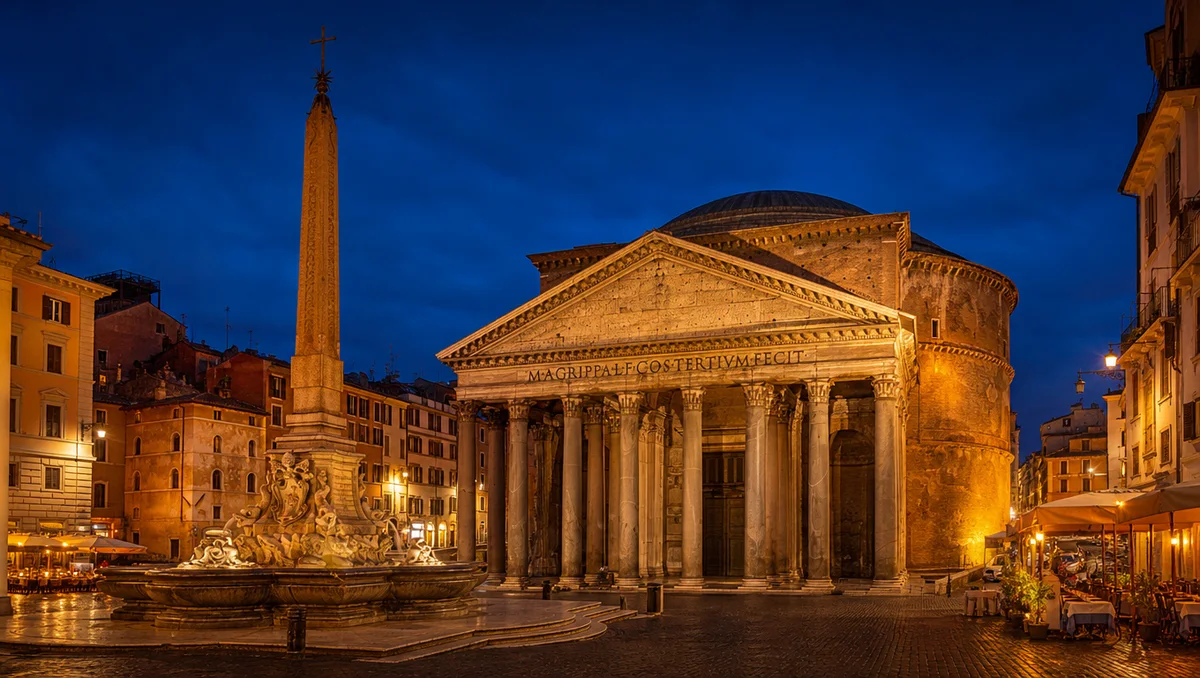
The Pantheon we see was finished under the emperor Hadrian and probably dedicated around AD 126, on the site of an earlier temple built by Marcus Agrippa. It has been a church since 609, which is the main reason it survived almost intact.
Most visitors spend ten minutes looking up. This guide is for the other thirty: where the light goes, why the floor has holes, and whose tombs line the walls.
The quick answer
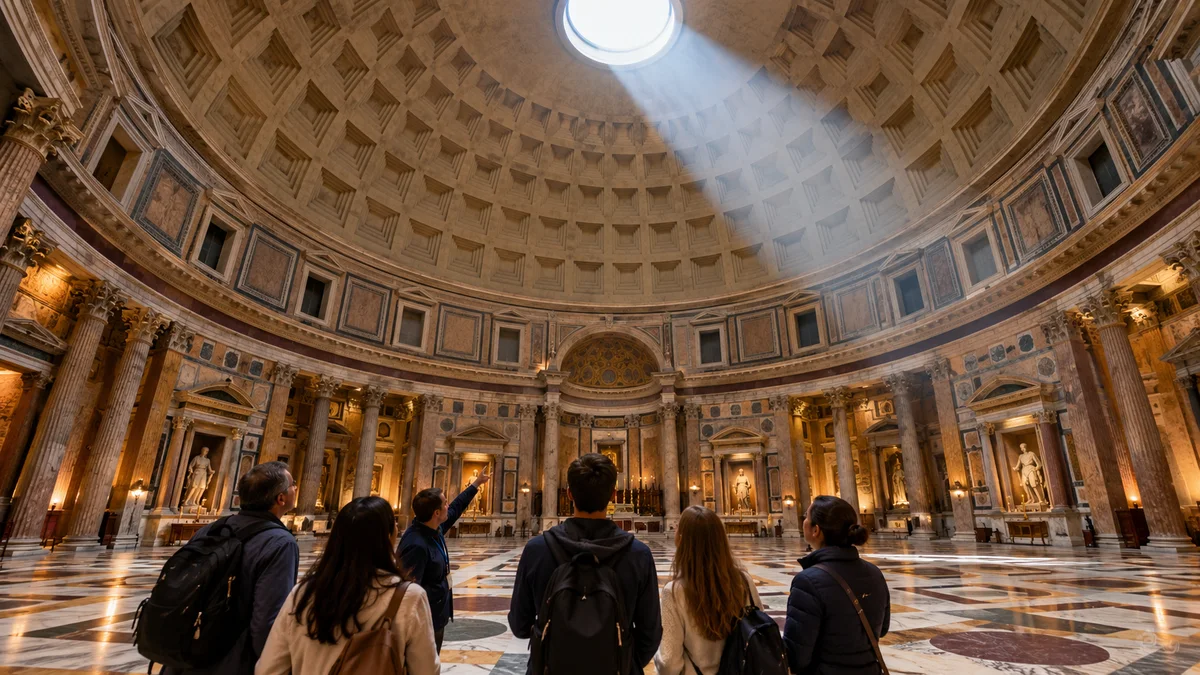
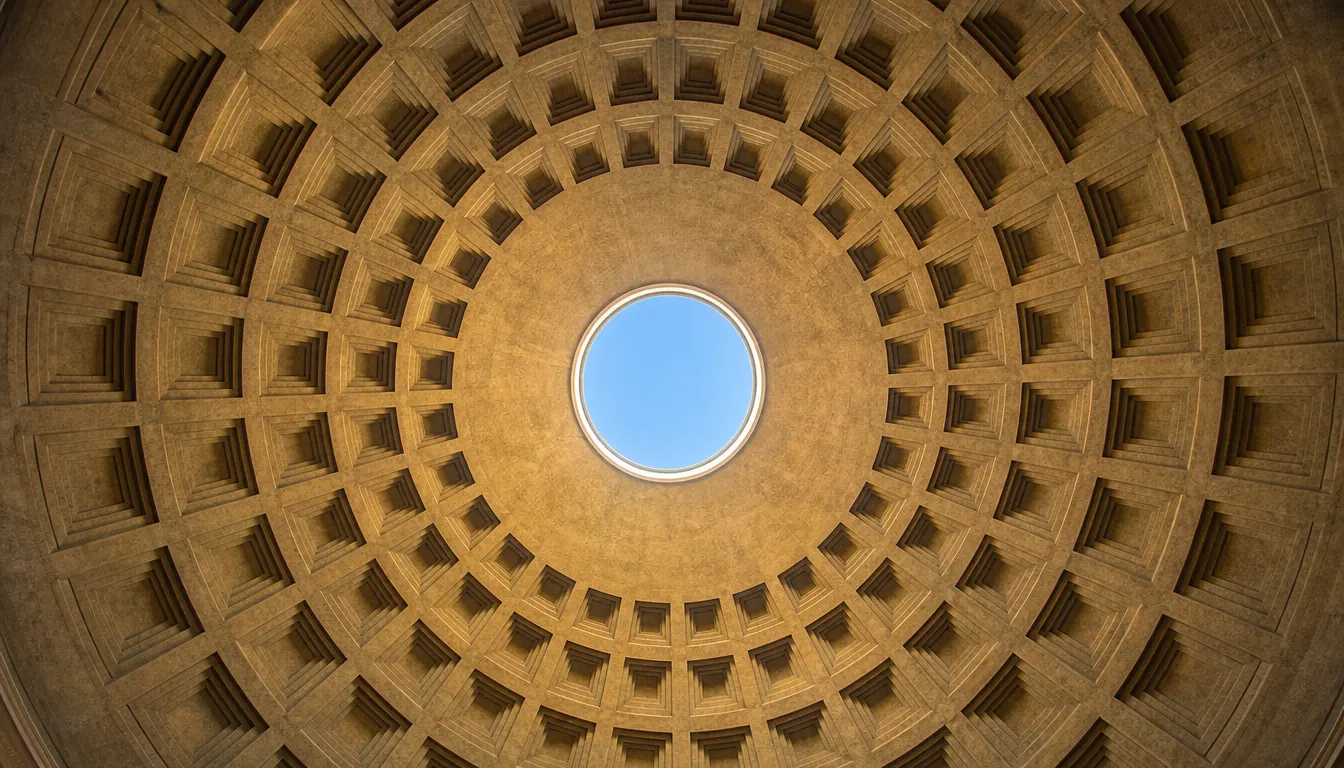
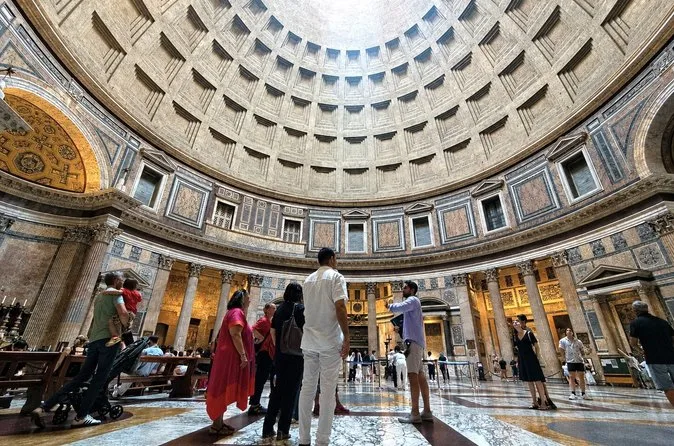
The oculus is about 9 metres across and open to the sky: rain falls in and drains through 22 holes in a slightly domed floor. The dome is 43.3 metres wide and as high, the largest unreinforced concrete dome in the world, built with lighter stone towards the top. Inside, find Raphael's tomb, two kings of Italy, the 7th-century icon above the high altar, and the original bronze doors.
How big is the Pantheon's oculus, and why is it open?
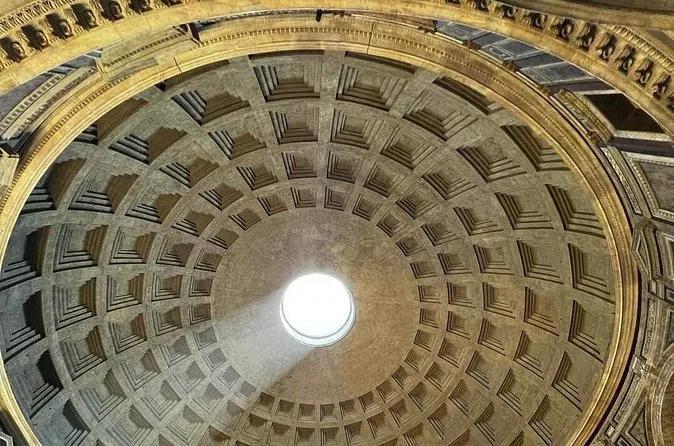
About 9 metres across (Turismo Roma gives 8.92 m), at the top of a dome 43.3 metres wide and 43.3 metres high. It has never had glass.
The dome would fit a sphere 43.3 metres across exactly, touching the floor. The oculus is its only window. It also lightens the dome at its weakest point: the crown, where a solid cap would push hardest on the walls. The ring of brick and concrete around the hole carries the load instead.
Sources: Wikipedia and Turismo Roma.
What happens when it rains in the Pantheon?
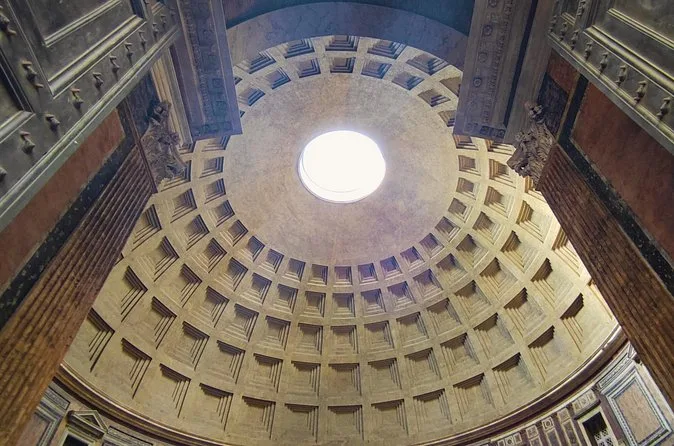
It rains inside. The water falls straight down through the oculus and drains through 22 holes in the floor, which rises about 30 cm towards the centre.
Look down at the marble right under the oculus and you'll find the drains. One guest on the semi-private tour described the moment: “He pointed up at the oculus, paused, and said, "Rain falls in… look down." Barely visible drains in the marble floor.” The rest of the room stays dry, and on a drizzly day the column of falling water is worth the trip on its own. A guest on the Elite tour loved "the ethereal drizzle coming through the ceiling [...] proving the dome top is open and not covered in glass."
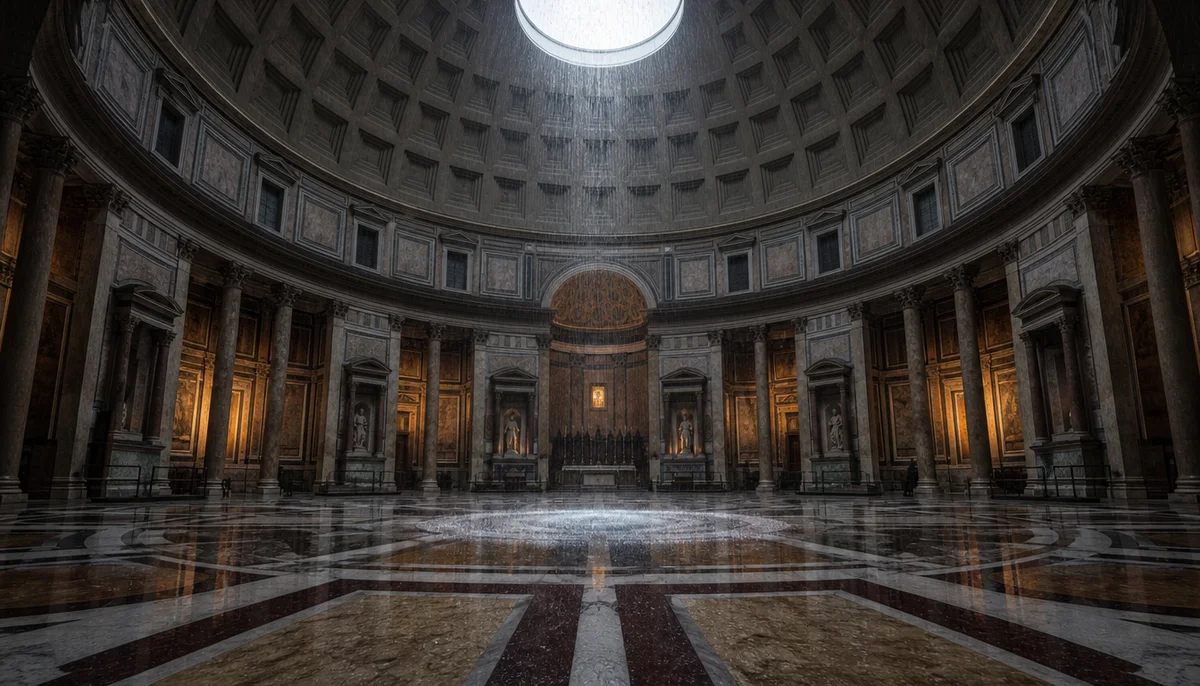
Ask an archaeologist about the dome while you stand under it: up to 10 guests, entry included.
Check dates for the tour with an archaeologistHow did the Romans build the Pantheon dome?
With unreinforced concrete poured in layers that get lighter towards the top: travertine at the base, then tile, then tuff and pumice near the oculus.
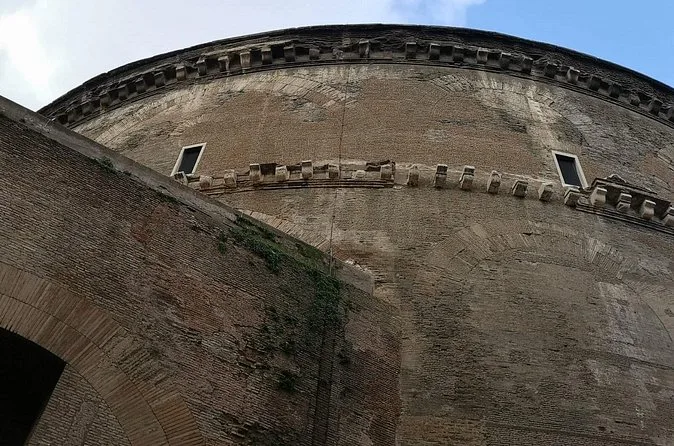
The wall is 6.4 metres thick at the base of the dome and thins to about 1.2 metres around the oculus. The dome weighs about 4,535 tonnes, and the coffers cut into it remove weight without weakening it. Eight barrel vaults hidden in the drum wall carry the load down. Nearly 1,900 years later it is still the largest unreinforced concrete dome in the world.
Guides keep this for the moment you're standing under it. One guest on the semi-private tour: "Then he whispered: lighter pumice near the top, heavier basalt below."
Where does the sunlight fall inside the Pantheon?
A disc of sun moves across the dome and walls through the day. Around the June solstice it reaches the floor; at noon on 21 April it lights the entrance.
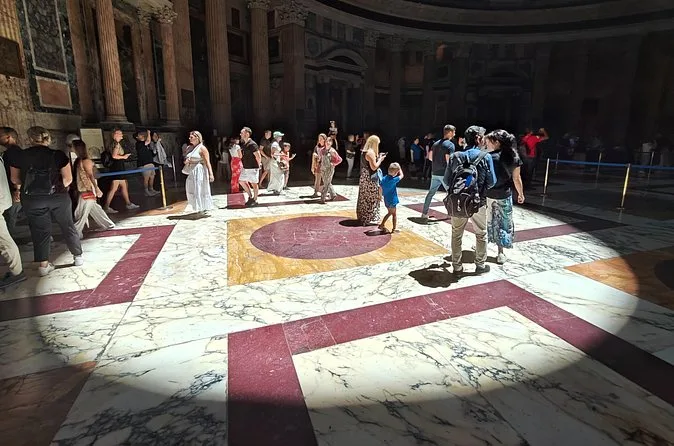
On 21 April, the traditional birthday of Rome, the midday sun through the oculus falls on the doorway, an effect many scholars think was designed so the emperor could walk in bathed in light. Around the summer solstice the disc lands on the floor, Turismo Roma says with the same diameter as the oculus. On any sunny day you can watch the beam creep across the coffers.
For a photo, one guest recommends "holding the phone at waist level and looking up."
Whose tombs are inside the Pantheon?
Raphael's, two kings of Italy and a queen, and the painters Annibale Carracci and Baldassare Peruzzi, with the composer Arcangelo Corelli.
- Raphael (died 1520) asked to be buried here. Above his tomb stands the Madonna del Sasso, carved by his pupil Lorenzetto in 1524. The epitaph by the poet Pietro Bembo says that while Raphael lived, Nature feared to be outdone, and when he died she feared she would die too. A plaque nearby remembers Maria Bibbiena, his fiancée.
- Vittorio Emanuele II, the first king of united Italy, and Umberto I with Queen Margherita, the queen the pizza is named after, lie in niches on opposite sides of the rotunda.
- Annibale Carracci, Baldassare Peruzzi and Arcangelo Corelli are buried here too.
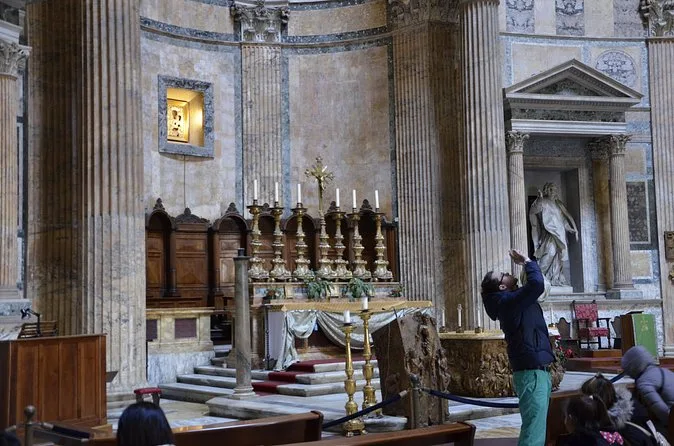
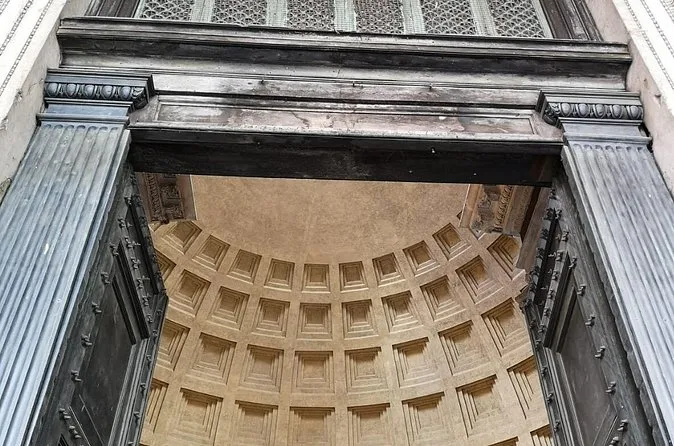
An archaeologist walks you round the tombs, the dome and the floor, with 10 guests at most.
Explore the tour with an archaeologist Tour detailsWhat else should you look for inside?
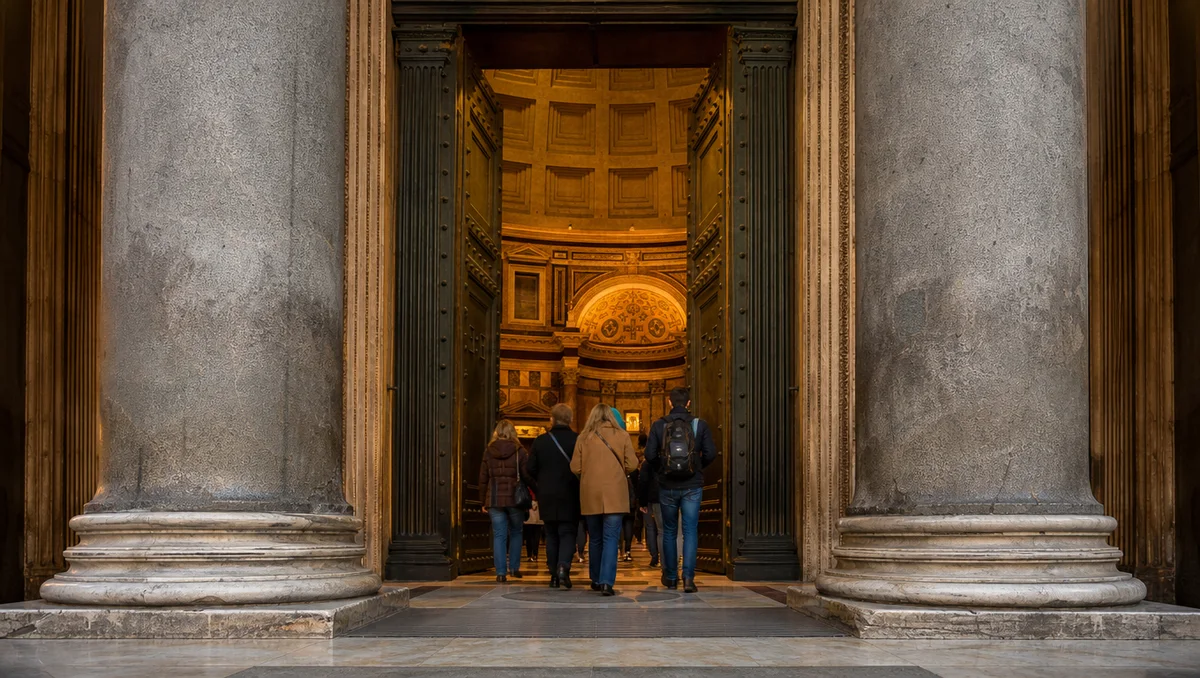
The marble floor, the icon above the high altar, the side chapels and the bronze doors you walked through.
- The floor: squares and circles of porphyry, granite and coloured marble. It was relaid in the 19th century as a faithful copy of Hadrian's design.
- The high altar: a 7th-century Byzantine icon of the Madonna and Child, from the years the temple became a church.
- The doors: 7.53 metres high, Roman bronze. Long thought to be a later replacement, they are now believed to be original, restored over the centuries.
- The walls: guides point out the empty spaces along the wall and how the room looked in different periods.
What should you see on the portico and the piazza?
Sixteen granite columns brought from Egypt, the Agrippa inscription, and the obelisk fountain. Then walk round the back.
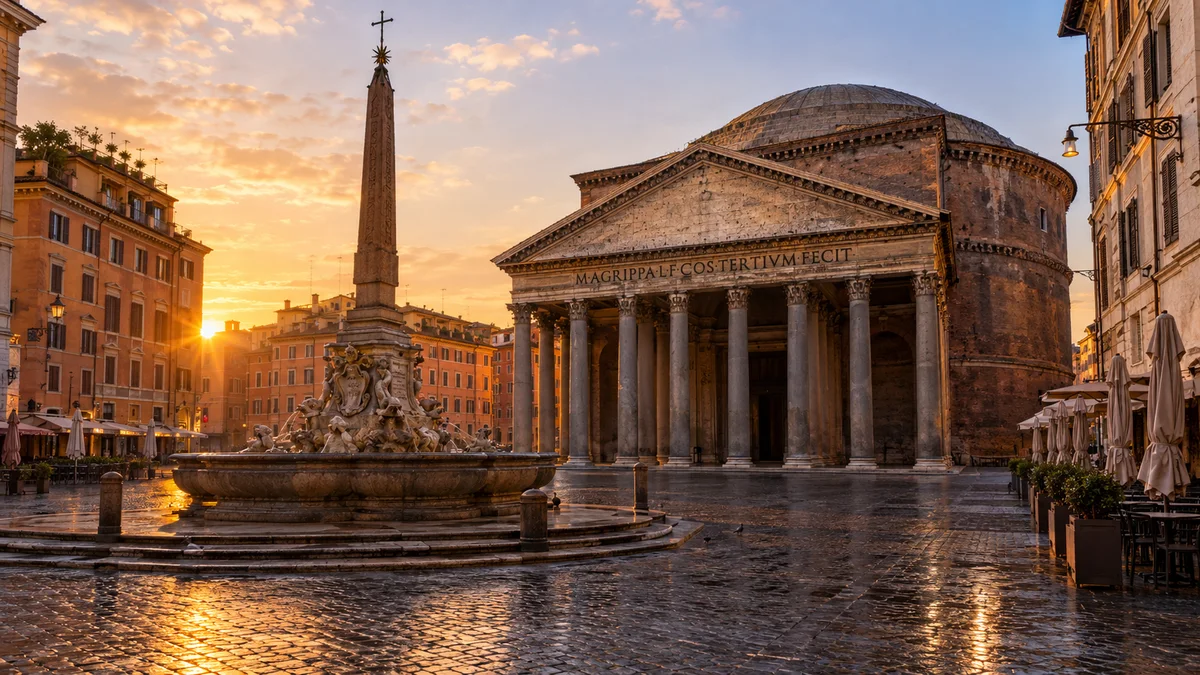
Each column is 11.9 metres tall, 1.5 metres thick and weighs about 60 tonnes; eight stand in front and two groups of four behind. The inscription reads M AGRIPPA L F COS TERTIVM FECIT, Marcus Agrippa made this when consul for the third time, though the building you see is Hadrian's. Pope Urban VIII Barberini stripped the portico's bronze in the 1600s, which gave Rome the joke quod non fecerunt barbari, fecerunt Barberini: what the barbarians didn't do, the Barberini did.
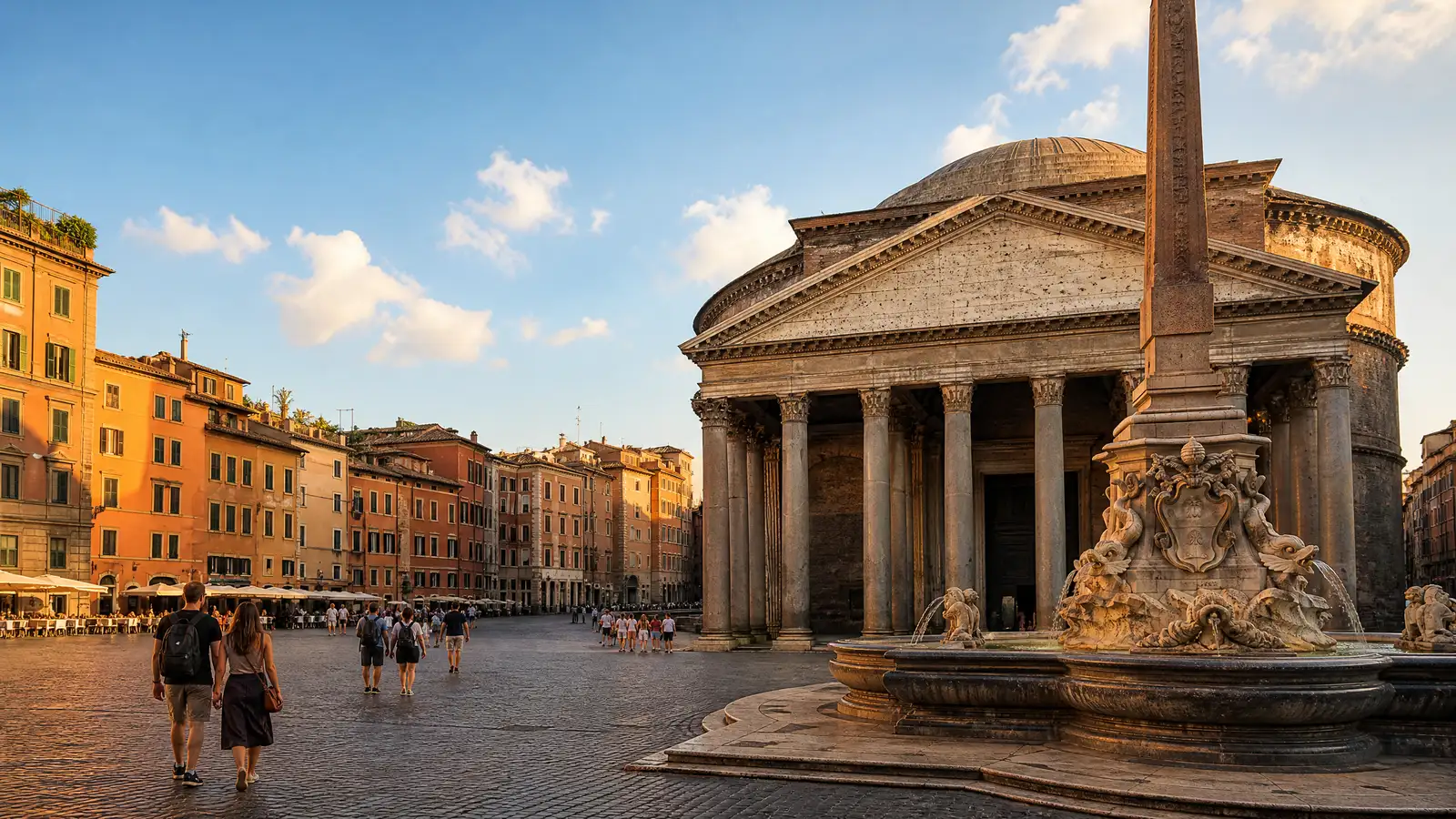
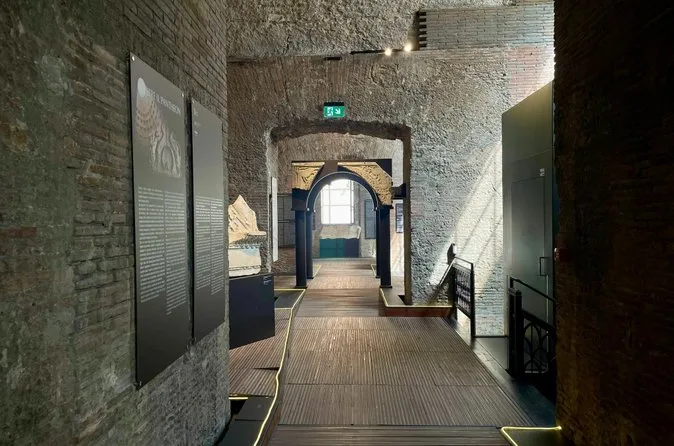
The fountain in front is Giacomo della Porta's (1575), with an obelisk of Ramesses II added in 1711. Behind the rotunda are the brick walls of the Basilica of Neptune, visited on the Gyde Tours visit.
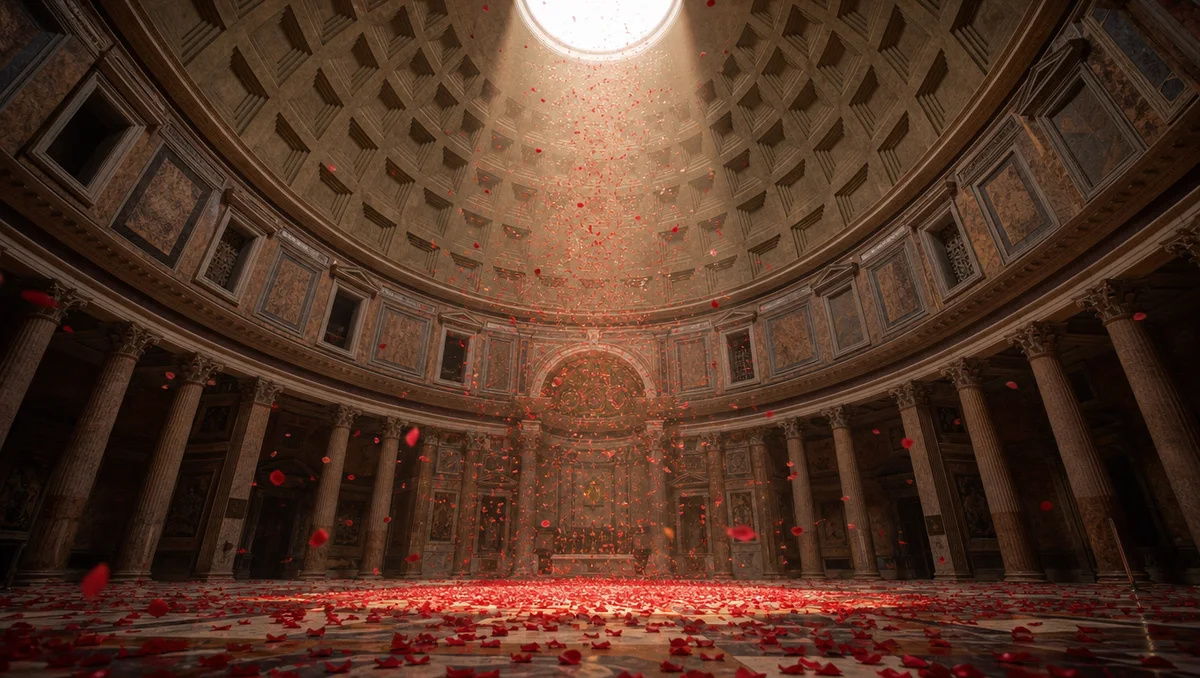
When do rose petals fall through the oculus?
On Pentecost Sunday, at the end of the 10:30 Mass. In 2027 that is Sunday 16 May.
Rome's firefighters climb onto the dome and drop red rose petals through the oculus, a symbol of the Holy Spirit. Entry for Mass is free, but people queue for hours. The Pentecost 2027 post has the plan; the hours guide covers normal Sundays.
Not here at Pentecost? A semi-private guide shows you the drains, the dome and the tombs any day.
Check dates for the semi-private tourFrequently asked questions
Why is there a hole in the Pantheon roof?
The oculus lights the whole room and lightens the dome at its weakest point. It has always been open to the sky.
Does it rain inside the Pantheon?
Yes. Rain falls through the oculus and drains through 22 holes in the floor, which slopes gently away from the centre.
Who is buried in the Pantheon?
Raphael, kings Vittorio Emanuele II and Umberto I, Queen Margherita, Annibale Carracci, Baldassare Peruzzi and Arcangelo Corelli, among others.
How big is the Pantheon dome?
43.3 metres across and 43.3 metres high to the oculus, which is about 9 metres wide.
Ready to book
Choose your visit
Free cancellation up to 24 hours before on every option. Prices are from-prices in USD and move with the season.
Semi-Private Pantheon Tour with an Archaeologist
Up to 10 guests with archaeologist Olga Di Cagno
Semi-Private Pantheon Tour with Entry
A licensed guide for 10 guests at most, entry included
Pantheon and the Hidden Basilica of Neptune
Pantheon entry plus a guided visit to the Roman hall behind it